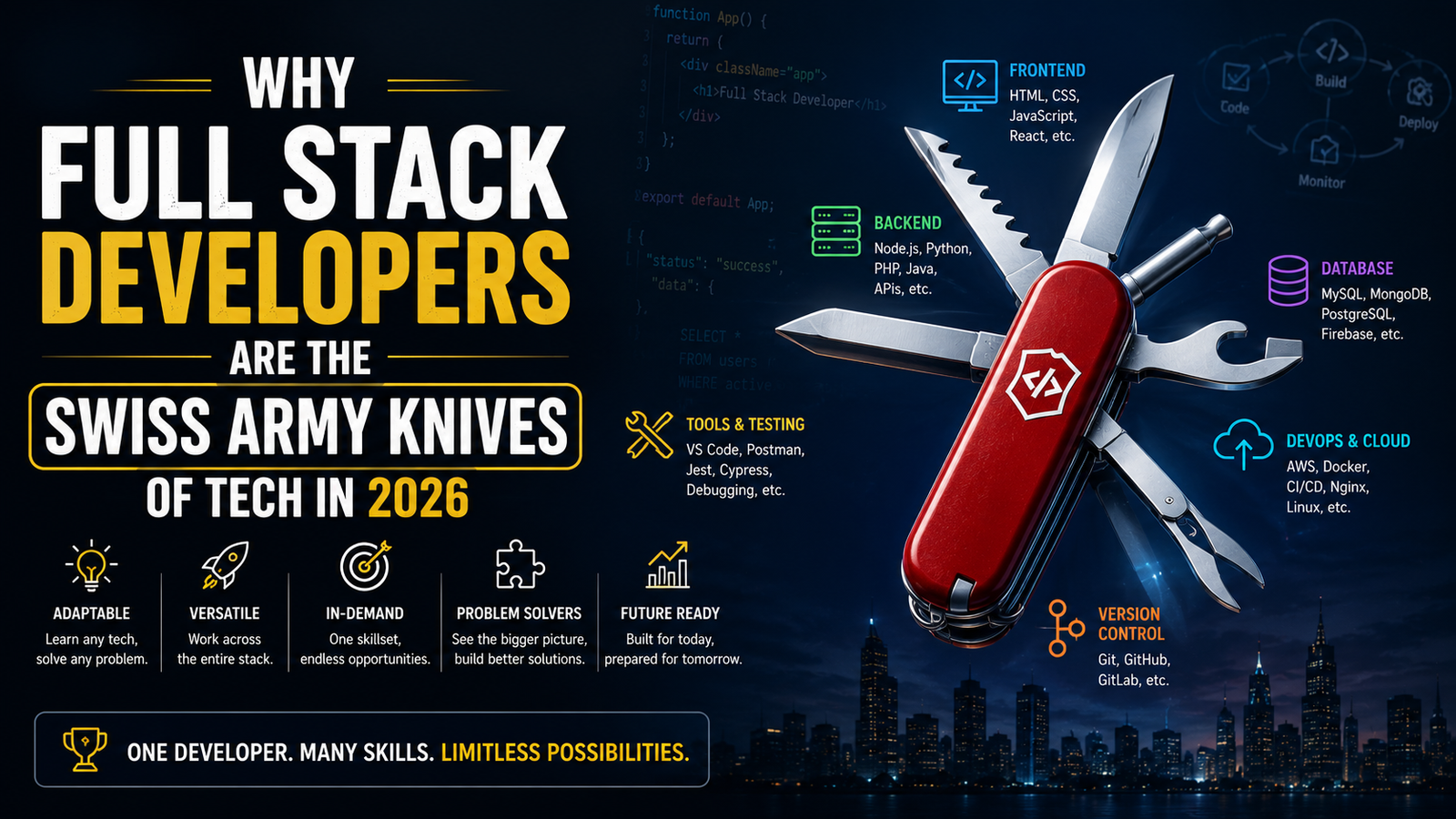
There's a reason "full stack developer" is one of the most searched job titles on every hiring platform. In a world where startups need to move fast and enterprises need lean teams, the developer who can walk from a MongoDB schema to a polished ReactJS interface — without waiting on three different specialists — is the one who gets hired first and laid off last.
What "Full Stack" Actually Means in 2026
Full stack isn't about being equally brilliant at everything. It's about being dangerous enough at every layer of the stack — frontend, backend, database, and deployment — that you can ship a working product alone or lead a team that builds one. A typical modern full stack developer's toolkit looks like this:
- Frontend: ReactJS, HTML, CSS, JavaScript
- Backend: Node.js, PHP, or Python
- Database: MongoDB, MySQL, Oracle
- Bonus skills: Angular, C++, Ruby, SQL fundamentals
Why Companies Are Obsessed With Full Stack Hires
Hiring a full stack developer is often cheaper and faster than hiring a frontend specialist, a backend specialist, and a DBA separately. For early-stage startups, this isn't a preference — it's survival. One person who understands how a POST request from a React form travels through an Express route, gets validated, and lands in a MongoDB collection can debug in minutes what a fragmented team might spend a day tracing.
The Real Challenge: Depth vs. Breadth
The biggest myth about full stack development is that it means "knowing a little of everything." The developers who actually get promoted go deep on at least one layer (usually backend or frontend) while staying fluent — not expert — everywhere else. If you're just starting out, pick a primary stack (MERN, MEAN, or a PHP + MySQL combo) and get uncomfortably good at it before spreading wide.
A Simple Roadmap
- Master HTML, CSS, and JavaScript fundamentals — don't skip this for React.
- Learn one frontend framework deeply (ReactJS is the safest bet in 2026).
- Pick one backend runtime (Node.js is beginner-friendly; Python if you want ML crossover).
- Learn SQL and NoSQL — MySQL/Oracle for structured data, MongoDB for flexible schemas.
- Build three real projects that touch every layer, not tutorials you forget in a week.
Full stack development isn't going anywhere in 2026 — if anything, AI coding assistants have made it easier to move across layers, which means the bar for what counts as "full stack" is rising, not falling.